 Nature GO
Spider identifier app: how to name the spider you just saw
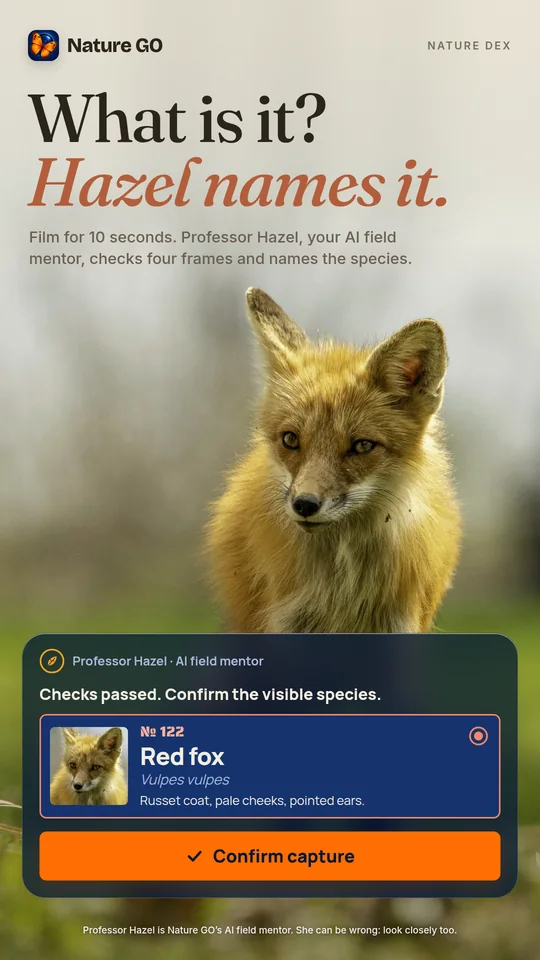
Stay well back, film the spider steady with its whole body in frame, then check the species the app suggests. Nature GO is a free animal identifier for Android and iPhone that works from a ten-second video filmed live in the app. It names spiders as well as birds, insects, mammals, plants and snakes. It never tells you whether a spider is dangerous.
 Scan with your phone to install
This week: most observed spiders in the United States
Over the last 7 days (November 15 to 21, 2026), the most observed spiders in the United States on iNaturalist were Bold Jumping Spider (111 observations), Banded Garden Spider (60) and Western Black Widow (58). In all, 1,451 community-confirmed spider observations for this period.
No species is clearly rising compared with the previous 4 weeks.
6 of these 10 species are among the 1,000 in the Nature GO Dex: film one for 10 seconds to add it.
| # | Species | This week | Weekly avg. before |
|---|---|---|---|
| 1 | Bold Jumping Spider Phidippus audax In the Dex | 111 | 390 |
| 2 | Banded Garden Spider Argiope trifasciata | 60 | 154 |
| 3 | Western Black Widow Latrodectus hesperus | 58 | 102 |
| 4 | Noble False Widow Steatoda nobilis | 51 | 87 |
| 5 | Joro Spider Trichonephila clavata In the Dex | 51 | 208 |
| 6 | Triangulate Combfoot Steatoda triangulosa | 47 | 89 |
| 7 | Spinybacked Orbweaver Gasteracantha cancriformis In the Dex | 45 | 111 |
| 8 | Golden Silk Spider Trichonephila clavipes In the Dex | 40 | 86 |
| 9 | Brown Widow Latrodectus geometricus In the Dex | 38 | 65 |
| 10 | Cross Orbweaver Araneus diadematus In the Dex | 38 | 142 |
Source: iNaturalist, research-grade observations (identification confirmed by the community). Read on November 22, 2026. Common names: iNaturalist’s English names, otherwise the app’s name or the scientific name.
“Weekly avg. before”: weekly average of the previous 4 weeks (October 18 to November 14, 2026). An observation is a record published by an observer, not a count of individuals. “Rising”: the species’ share of the week’s observations is at least twice its earlier share, with at least 8 observations.
Most observed spiders in the United States
According to GBIF, the most observed spiders in the United States over the latest 30 days available (September 18 to October 17, 2026) were Bold Jumper (413 records), Banded Garden Spider (130) and Yellow Garden Spider (127). In all, 3,290 spider records for this period.
| # | Species | Records |
|---|---|---|
| 1 | Bold Jumper Phidippus audax | 413 |
| 2 | Banded Garden Spider Argiope trifasciata | 130 |
| 3 | Yellow Garden Spider Argiope aurantia | 127 |
| 4 | Garden Spider Araneus diadematus | 107 |
| 5 | Nursery Web Spider Pisaurina mira | 101 |
| 6 | Northern Black Widow Latrodectus variolus | 98 |
| 7 | Steatoda nobilis | 96 |
| 8 | Spotted Orbweaver Neoscona crucifera | 93 |
| 9 | Marbled Orbweaver Araneus marmoreus | 67 |
| 10 | Tan Jumping Spider Platycryptus undatus | 67 |
Source: GBIF.org, data from the contributing datasets (human observations under CC0 or CC BY licences only). Read on November 22, 2026. Common names come from GBIF name lists and are kept when at least two sources agree; otherwise the scientific name is shown.
A record is one published observation, not one animal: this ranks what observers published, not how many animals live there.
GBIF receives some data late, often by several weeks: the period shown ends on October 17, 2026, and later observations are not all counted yet.
This list says nothing about danger. Never decide whether a spider is dangerous, or what care a bite needs, from an identification: call emergency services after a bite.
Safety first
Never decide from an identification whether a spider is dangerous or what care a bite needs. The name an app suggests is a hypothesis that can be wrong, and Nature GO never says whether an animal is venomous or harmless. After a bite, call emergency services at once (112 in Europe, 911 in the US) and do not wait for an identification. Do not touch, catch or move a spider to film it.
Film a spider from a safe distance
- Zoom instead of getting close. A spider never needs to be touched, cornered or moved for a good answer. Film it where it is.
- Whole body in frame. The markings on the abdomen, the pattern on the legs and the overall shape are what an identifier compares. A web or a crack can hide them.
- Keep the camera steady. Nature GO checks four frames from the ten seconds, so a steady shot from slightly different angles says more than one photo.
- Check the suggestion. An identification is a hypothesis you confirm. When the image is not clear enough, the app says so instead of guessing.
What we measured
On 21 October 2026 we ran the Nature GO identification engine on three spider photos from Wikimedia Commons, outside the video flow of the app. It found the right genus every time: two answers stopped at genus level (widow spiders, recluse spiders), and the third proposed another species of the right genus with low confidence, Argiope trifasciata for a wasp spider (Argiope bruennichi). Three photos are a small sample, not an accuracy rate. Spiders are often given at genus level on purpose: many species look alike, and a careful answer beats a wrong one.
What happens to your find
Every confirmed capture is kept. Several spiders have their own entries in the nature dex of 1,000 widespread species, among them the European garden spider (Araneus diadematus) and the zebra jumping spider (Salticus scenicus). Any other spider goes to Beyond the 1,000.
What it does not tell you
Nature GO never says whether a spider is venomous, harmless or safe to handle, and it gives no medical advice. It does not identify from sounds, and it needs an internet connection. It can suggest a name for a spider in a photo from your gallery, but that photo never adds an entry to your nature dex: only video filmed live in the app does. Looking for snakes? See the snake identifier page.
Nature GO at a glance
- Publisher
- IVRYN.
- Price
- Free, with 3 analyses a day. Optional Nature GO Plus: 10 analyses a day while the service has capacity, 30, 90 and 365-day field reports and a text export.
- Account
- None to create. Notes and place labels stay on your phone.
- Android
- On Google Play.
- iPhone
- On the App Store.
- Catalogue
- 1,000 species in 5 drawers: 425 birds, 248 plants, 176 insects, 62 mammals and 89 others (frogs, lizards, snails, spiders, fungi).
- Method
- A live video of about 10 seconds filmed in the app while you move the phone left or right as asked. The server checks 4 frames, then suggests a species. The app can also suggest a name from a gallery photo, with its own daily allowance, but only the live video adds a species to the catalogue.
- Languages
- App in 10 languages: English, French, Spanish, German, Italian, Portuguese, Japanese, Korean, Russian and Polish.
- Safety
- Never says whether a plant, fungus or animal is edible, venomous or safe.
Facts read on November 10, 2026 on Google Play, the App Store and in the app code.
FAQ
Is the spider identifier free?
Yes. Filming, identification and the nature dex are free. Nature GO Plus adds longer field reports, a text export and more Professor Hazel analyses a day.
Does Nature GO tell me if a spider is dangerous?
No. It names the species it sees but never judges venom or danger. Never decide a danger or a treatment from an identification, and after a bite call emergency services.
Can I identify a spider from a photo in my gallery?
Yes. Pick a photo from your gallery and Professor Hazel, the app's AI, suggests a name. Photos have their own daily allowance, separate from video analyses: 3 a day for free, 10 with Nature GO Plus. A photo never adds an entry to your nature dex: only video filmed live in the app does.
Is Nature GO on iPhone?
Yes. Nature GO is available on the App Store for iPhone and on Google Play for Android.
Which spiders are being observed in the United States right now?
Over the last 7 days (November 15 to 21, 2026), the most observed spiders in the United States on iNaturalist were Bold Jumping Spider (111 observations), Banded Garden Spider (60) and Western Black Widow (58). In all, 1,451 community-confirmed spider observations for this period. No species is clearly rising compared with the previous 4 weeks. Read on November 22, 2026.
What are the most observed spiders in the United States?
According to GBIF, the most observed spiders in the United States over the latest 30 days available (September 18 to October 17, 2026) were Bold Jumper (413 records), Banded Garden Spider (130) and Yellow Garden Spider (127). In all, 3,290 spider records for this period. Read on November 22, 2026.
Guides
- Nature GONature GO: identify animals, bugs and plants on video
- How to identify an animal from a photo or a video
- Insect identifier app: how to identify a bug you just found
- Snake identifier app: how to name the snake or spider you just saw
- Bird identifier app: how to name the bird you just saw
- Plant identifier app: how to name the flower, leaf or tree in front of you
- How Nature GO identifies an animal from a 10-second video
- Nature GO review: what the app really does
- Is Picture Insect free?
- All species in the Dex