 Nature GO
How Nature GO identifies an animal from an 8-second video
You film the animal live in the app for about eight seconds while moving the phone the way the app asks. A server samples four frames, checks that they come from one real scene, then suggests a species with the visible evidence behind it. You confirm the suggestion before it enters your nature dex. Nature GO is free on Android, with 3 analyses a day.
 Scan with your phone to install
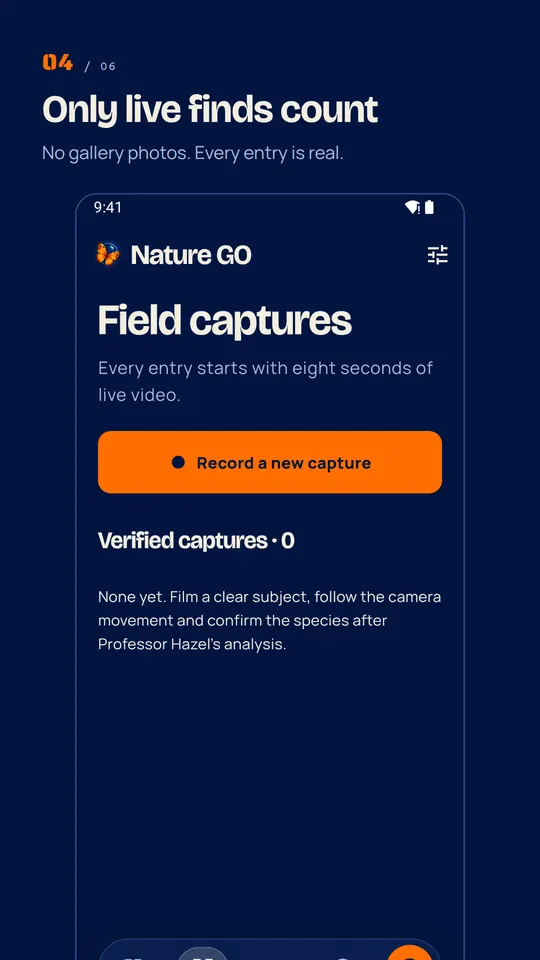
1. A live clip, never a photo
Nature GO only accepts video filmed in the app. Gallery photos and imported files are refused, so every entry in the dex is something you actually found. Before you record, the app gives one movement to make: keep the subject in frame and move the phone slowly to the left, or to the right. The direction is drawn at random for each clip and the challenge expires after ten minutes.
2. Four frames checked on the server
You choose whether to send each clip. The server decodes it, keeps four frames spread across the recording and looks at three things: whether the frames show one coherent natural scene, whether the camera moved as asked, and whether there are signs of a screen or a printed picture, such as borders, pixels or moiré. These checks are informative, not forensic: a clip is refused only when a screen or print is suspected and the frames do not hold together.
3. A suggestion with its evidence
The identification returns up to three candidates, from species to genus or family, each with a confidence level and the visible features it relies on, for example a bill colour, a wing pattern or the shape of a leaf. When the evidence is thin, the answer stays at genus level or says it is uncertain instead of guessing. A clip is accepted when a living subject is named and at least three of the four frames differ. You review the suggestion before you confirm it, and only confirmed, server-verified captures fill the catalogue of 151 species.
4. Why a clip can come back without an answer
- Not enough evidence: no living subject could be named. Film closer and steadier, with the whole animal in frame.
- Frames too still: fewer than three different frames, for example a video of a still image.
- Screen or print suspected: the frames look like a screen or a printed page and do not form a coherent scene.
- New clip needed: the challenge has expired, the clip was already used or it is larger than 16 MB. Record a new one.
- Analysis paused: no connection, the daily limit is reached or the service is busy. The clip stays pending.
5. What we measured
On 21 October 2026 we ran the identification engine on eight reference photos from Wikimedia Commons, outside the video flow of the app. It named the five snakes to the exact species: western diamondback rattlesnake, ball python, corn snake, Indian cobra and common garter snake. For the three spiders it found the right genus: two answers stopped at genus level (widow spiders, recluse spiders), and the third proposed a species of the right genus with low confidence, Argiope trifasciata for a wasp spider (Argiope bruennichi). Eight photos are a small sample, not an accuracy rate.
6. Limits
An identification is a suggestion, not a guarantee. Nature GO never says whether a plant, fungus or animal is edible, venomous or safe. It needs an internet connection, and analysis pauses when the daily limit is reached: 3 analyses a day for free, 10 with Nature GO Plus while the service has capacity. Notes and place labels stay on your phone and are never sent for analysis.
Nature GO at a glance
- Publisher
- IVRYN.
- Price
- Free, with 3 analyses a day. Optional Nature GO Plus: 10 analyses a day while the service has capacity, 30, 90 and 365-day field reports and a text export.
- Account
- None to create. Notes and place labels stay on your phone.
- Android
- Version 1.12.4 on Google Play, updated October 23, 2026.
- iPhone
- Not on the App Store (checked October 23, 2026). A public beta is open on TestFlight.
- Catalogue
- 151 species in 5 drawers: 42 birds, 45 plants, 34 insects, 15 mammals and 15 others (frogs, lizards, snails, spiders, fungi).
- Method
- A live video of about 8 seconds filmed in the app while you move the phone left or right as asked. The server checks 4 frames, then suggests a species. Gallery photos are refused.
- Languages
- App in 10 languages: English, French, Spanish, German, Italian, Portuguese, Japanese, Korean, Russian and Polish.
- Safety
- Never says whether a plant, fungus or animal is edible, venomous or safe.
Facts read on October 23, 2026 on Google Play, the App Store and in the app code.
FAQ
Can Nature GO identify an animal from a photo?
No. It only accepts a video of about eight seconds filmed live in the app. Gallery photos and imported files are refused.
How many identifications are free?
Three analyses a day are free. Nature GO Plus raises the limit to ten a day while the service has capacity, and adds longer field reports and a text export.
Does Nature GO say if an animal or a mushroom is dangerous or edible?
No. It suggests a name and never judges whether a plant, fungus or animal is edible, venomous or safe.
Does it work offline?
No. The clip is analysed on a server, so identification needs an internet connection. Your notes and place labels stay on your phone.